Public Markets Are Africa’s Missing Domestic Capital Engine
Public Markets Are Africa’s Missing Domestic Capital Engine
Africa does not only need more investors. It needs more investable companies. Public markets are where domestic savings, governance discipline, reporting standards, and investor confidence can begin to compound.
Africa does not suffer from a lack of ambition. It suffers from a shortage of long-term, locally anchored capital that can survive political cycles, commodity cycles, foreign-exchange shocks, and changes in international risk appetite.
That distinction matters.
For too long, the conversation around African capital formation has been dominated by external money: development finance, concessional capital, foreign direct investment, sovereign Eurobonds, international private equity, and donor-backed blended finance. All of these sources matter. None of them are sufficient.
The more durable question is this: how does Africa convert domestic savings into productive investment?
Public markets are central to that answer.
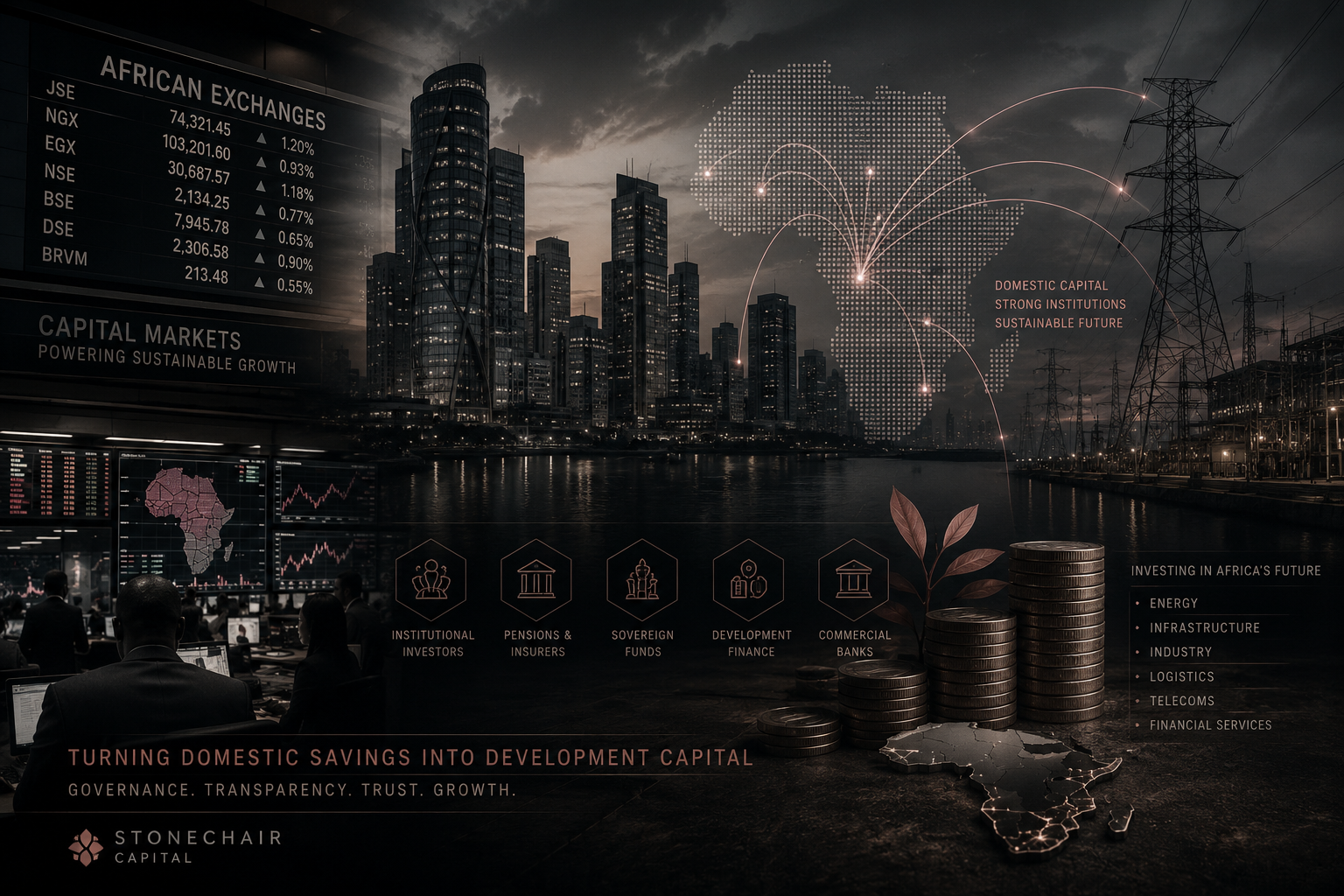
They are not merely venues for share trading. They are financial infrastructure. When properly developed, they provide price discovery, liquidity, governance discipline, reporting standards, minority shareholder protections, and institutional-investor access. They also create a bridge between private enterprise and public confidence.
That is not simply a capital-market statistic. It is a development constraint.
The Domestic Capital Problem Is Not Just Scarcity
The common narrative is that Africa lacks capital. That is incomplete.
Africa has domestic capital. It is held by pension funds, insurers, banks, sovereign wealth funds, development banks, family offices, corporates, and high-net-worth individuals. The challenge is that too much of this capital sits in low-risk, short-duration, government-linked instruments rather than productive corporate assets.
Africa Finance Corporation’s 2025 infrastructure work points to more than US$1.1 trillion in domestic capital across African pension funds, insurance funds, public development banks, and sovereign wealth funds.2 The issue is not only whether capital exists. It is whether that capital can find instruments, issuers, rules, and reporting standards that allow it to invest with confidence.
The result is a structural mismatch.
African economies need long-term capital for infrastructure, power, logistics, manufacturing, agriculture, digital infrastructure, and corporate expansion. Domestic institutions often need long-duration assets to match liabilities. Yet the investable universe remains narrow, disclosure is inconsistent, liquidity is thin, and many companies remain private, family-controlled, or underprepared for institutional scrutiny.
Public markets can help solve that mismatch.
Public Markets Create Governance Before They Create Liquidity
The strongest case for African public markets is not liquidity. It is governance.
Liquidity matters. But liquidity follows trust. Trust follows disclosure. Disclosure follows rules. Rules require institutions.
That is why public markets are valuable even before they become deep.
A company preparing to list must typically professionalize its board, improve financial controls, formalize shareholder rights, adopt audited reporting, disclose material information, clarify ownership, and submit to ongoing market supervision. Those changes are not cosmetic. They reduce information asymmetry between founders, managers, lenders, minority shareholders, regulators, and future investors.
This is especially important in sectors where Africa needs large-scale private capital: energy, infrastructure, logistics, telecoms, financial services, mining services, agriculture, and industrial platforms.
Several African jurisdictions now have corporate governance frameworks covering board composition, audit committees, financial reporting, shareholder rights, disclosure, and transparency obligations.3 The point is not that every African market is equally advanced. They are not. The point is that public-market architecture creates repeatable discipline that private transactions alone cannot deliver.
For investors, this matters because governance risk is not theoretical. It directly affects valuation, exitability, debt capacity, minority protection, and confidence in reported performance.
Reporting Is the Confidence Mechanism
Investor confidence is not built by promotion. It is built by evidence.
That evidence comes through reporting.
Annual reports, audited financial statements, board disclosures, ESG reporting, risk-factor disclosure, related-party transaction disclosure, and timely market updates all reduce the uncertainty discount applied to African corporates.
This is already visible in the direction of regulation. Kenya requires listed firms to disclose ESG performance annually. Tanzania requires listed companies to include ESG and sustainability reporting in annual reports. Mauritius encourages companies to report on environmental, social, and governance position, performance, and outlook through its governance code.4
These requirements are not merely compliance burdens. They are capital-access tools.
For African energy companies, this is particularly important. Energy assets are capital intensive, politically exposed, technically complex, and often dependent on long-term contracts, permits, land rights, grid access, tariff structures, and offtaker performance. Investors need more than a growth story. They need disciplined reporting on project economics, leverage, contract quality, construction risk, operating performance, community engagement, currency exposure, and regulatory dependency.
Better reporting can separate bankable companies from speculative ones.
Domestic Public Markets Reduce External Dependency
Africa’s reliance on external capital leaves companies and governments exposed to conditions they do not control.
When global interest rates rise, external capital becomes more expensive. When commodity prices fall, risk appetite contracts. When geopolitical shocks intensify, frontier-market allocations are often cut first. When donor budgets decline, concessional flows weaken. When currencies depreciate, foreign-currency debt becomes more difficult to service.
This is why domestic capital markets are strategic.
Domestic public markets cannot eliminate external shocks. But they can reduce dependence on them.
A stronger local equity market allows companies to raise capital in domestic currency. A deeper corporate bond market can reduce excessive reliance on bank lending. A broader base of listed issuers gives pension funds and insurers more options. Better market data improves pricing. More liquid exchanges create clearer exit paths. Over time, this reduces the cost of capital for companies that can meet market standards.
Where Each Capital Channel Fits
| Capital channel | Best use case in Africa | Strengths | Constraints | Investor-confidence effect |
|---|---|---|---|---|
| Private equity | Scaling founder-led platforms, energy developers, infrastructure services companies, and operating businesses before public-market readiness | Control rights, governance intervention, operational influence, flexible structuring | Illiquidity, hard exits, concentrated risk, valuation opacity | Builds governance and reporting discipline before broader institutional ownership |
| Public equity | Mature corporates needing growth capital, liquidity, broader ownership, and valuation transparency | Price discovery, liquidity, institutional access, minority participation | Thin liquidity in smaller exchanges, listing costs, ongoing disclosure burden | Converts private business performance into publicly verifiable investor evidence |
| Corporate bonds | Utilities, infrastructure platforms, telecoms, banks, industrial companies, and contracted cash-flow businesses | Local-currency funding, fixed-income institutional participation, tenor extension | Requires credit quality, ratings, covenant discipline, and predictable cash flows | Creates credit-history discipline and recurring market scrutiny |
| Green bonds / sustainability bonds | Renewable energy, grid modernization, water, transport, resilient infrastructure, and climate-aligned projects | Thematic investor demand, use-of-proceeds transparency, ESG reporting | Certification costs, reporting requirements, risk of weak pipeline | Links capital raising to measurable impact and project-level accountability |
| Infrastructure funds / listed vehicles | Operating power assets, toll roads, ports, transmission, storage, and brownfield infrastructure | Can match pension and insurance liabilities, provides recurring yield, creates aggregation | Needs stable regulation, contracted revenues, credible asset valuation | Turns long-duration infrastructure into investable domestic instruments |
| Blended finance | Early-stage or higher-risk infrastructure, first-loss capital, guarantees, project preparation | De-risks private capital, improves bankability, crowds in institutions | Can distort pricing if overused, requires strong governance | Helps transition assets from concessional dependency to commercial finance |
| DFI / MDB capital | Demonstration projects, policy-sensitive infrastructure, early market formation | Long tenor, technical support, credibility, catalytic effect | Limited scale relative to need, often slow execution | Signals bankability and improves confidence for follow-on private capital |
| Domestic pension and insurance capital | Listed equities, bonds, infrastructure funds, green bonds, and yield vehicles | Long-term liabilities, local-market knowledge, domestic-currency alignment | Often constrained by regulation, risk limits, and limited investable products | Anchors capital formation locally and reduces dependence on foreign cycles |
Public and Private Markets Should Reinforce Each Other
The debate should not be public markets versus private markets.
Africa needs both.
Private capital is often better suited to earlier-stage companies, infrastructure platforms, control transactions, turnaround situations, and assets that require operational restructuring. Public markets are better suited to scale, price discovery, broader ownership, liquidity, and long-term domestic institutional participation.
The strongest model is sequential.
Private capital helps companies professionalize, scale, improve governance, strengthen reporting, and prepare for institutional scrutiny. Public markets then provide the next layer of capital, liquidity, valuation transparency, and broader ownership.
In that model, a listing is not the end of the investment story. It is a graduation point.
Regional Integration Can Solve the Scale Problem
Many African exchanges are too small on a standalone basis.
That is not a reason to dismiss them. It is a reason to integrate them.
A domestic exchange can create local accountability, but regional linkage can create scale. The African Exchanges Linkage Project was designed to improve cross-border securities trading in Africa, with an initial phase linking seven African capital markets that represent more than 90% of Africa’s market capitalization.5
This matters because liquidity is a network effect.
More issuers attract more investors. More investors attract more issuers. Better market access improves pricing. Cross-border trading expands the investable universe. Regional settlement and custody improvements reduce friction. Harmonized rules improve confidence.
Africa’s capital markets do not need to copy New York, London, or Hong Kong. They need to become investable at regional scale.
The Investor Confidence Premium
The real value of public markets is that they can create a confidence premium.
Companies that meet higher reporting and governance standards should command better access to capital. Investors should be able to price them with more confidence. Lenders should have better information. Boards should be more accountable. Minority shareholders should have stronger protections. Regulators should have better visibility.
That confidence premium can become a competitive advantage for African corporates.
In a world where capital is more selective, companies that can produce credible audited numbers, disclose risk clearly, explain capital allocation, and operate under governance discipline will separate themselves from the market. This is true for listed companies. It is also true for private companies preparing to raise institutional capital.
For investors, the implication is direct: governance and reporting are not back-office issues. They are valuation issues.
For policymakers, the implication is equally direct: capital-market reform is not financial-sector housekeeping. It is industrial policy.
For African corporates, the message is blunt: the companies that prepare for public-market standards before they need public-market capital will have the advantage.
Conclusion: Public Markets Are Development Infrastructure
Africa’s financing gap will not be closed by foreign capital alone.
The continent needs domestic savings mobilized into productive investment. It needs companies that can absorb institutional capital responsibly. It needs exchanges that provide liquidity and accountability. It needs regulators that enforce disclosure. It needs pension funds and insurers that can invest beyond government securities. It needs private capital that builds companies capable of becoming public-market assets.
Public markets are not a luxury for Africa. They are part of the operating system for long-term development.
For African energy, the case is even stronger.
The continent needs more power, more grid investment, more renewable generation, more storage, more industrial electrification, and more bankable energy companies. That requires capital at scale. But capital at scale requires confidence at scale.
Public markets help create that confidence.
Public markets turn companies into accountable institutions. They turn savings into investment. They turn disclosure into trust. They turn governance into lower capital costs. They turn domestic capital from passive balance-sheet capacity into productive economic force.
#EnergyAfricaSources
- OECD, Africa Capital Markets Report 2025, public equity markets and corporate governance chapter. Source
- Africa Finance Corporation, State of Africa’s Infrastructure Report 2025. Source
- OECD, Africa Capital Markets Report 2025, corporate governance frameworks and disclosure requirements. Source
- OECD, Africa Capital Markets Report 2025, ESG and sustainability reporting examples for Kenya, Tanzania, and Mauritius. Source
- African Exchanges Linkage Project, cross-border securities trading and participating markets. Source