Imported Fuel Is Africa’s Macro Weakness. Energy Finance Is the Hedge.
Imported Fuel Is Africa’s Macro Weakness. Energy Finance Is the Hedge.
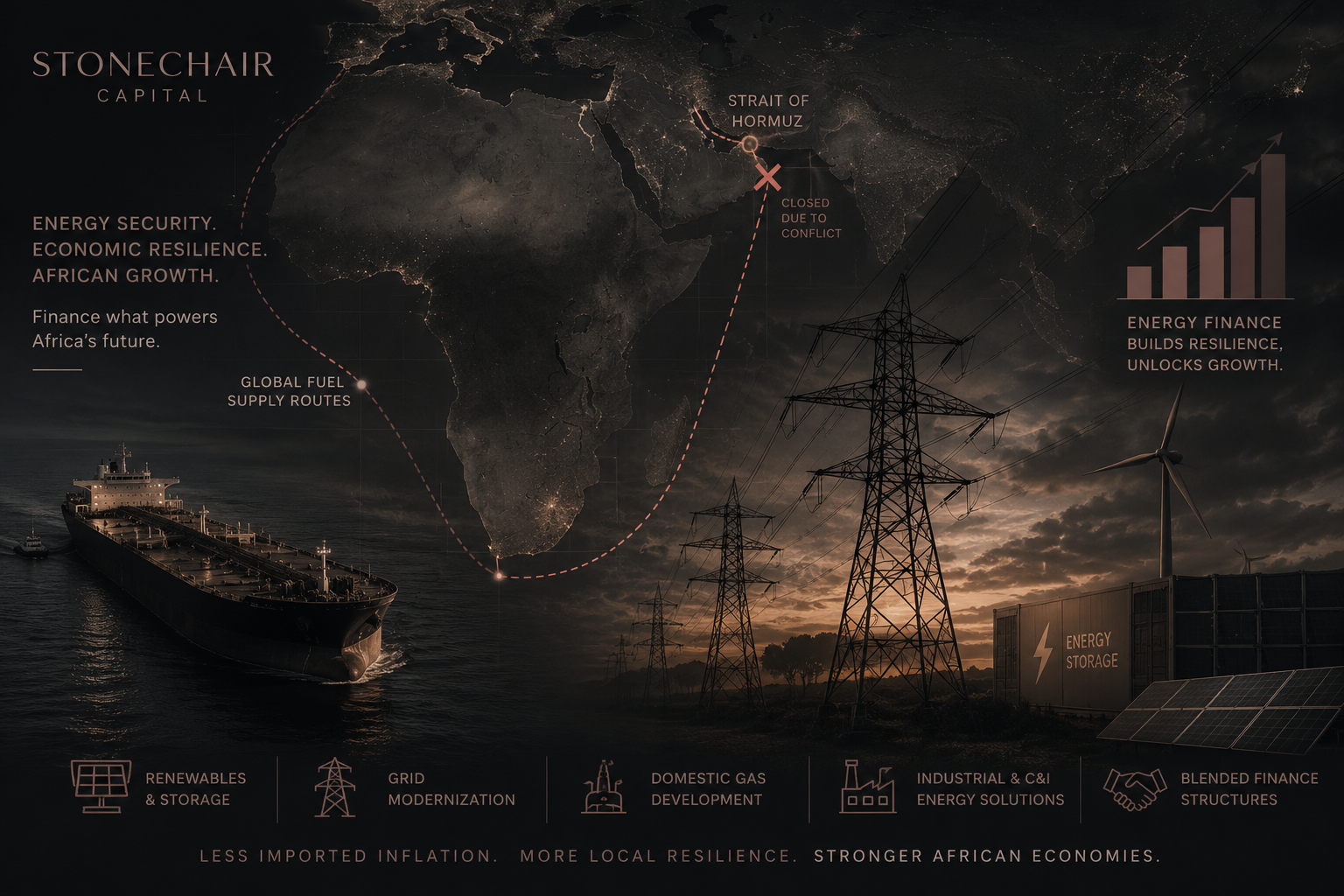
The Strait of Hormuz closure has turned imported fuel dependence into a live African macro risk. The investment response is not to wait. It is to finance energy resilience now.
The Strait of Hormuz is no longer a theoretical risk. It is a live energy shock.
With the Strait effectively closed or heavily restricted during the ongoing Iran-U.S. war, one of the world’s most important energy corridors has become a direct pressure point on African economies. Oil, LNG, refined fuels, shipping insurance, fertilizer, foreign exchange, inflation, and interest rates are now moving through the same channel.1
This is not only a Gulf crisis.
It is already inside African fuel prices, inflation prints, central-bank decisions, utility balance sheets, and project-finance models.
The lesson is simple: imported fuel dependence is not only an energy issue. It is a macroeconomic liability.
For Africa, the transmission is direct. Crude rises. Diesel rises. Food transport rises. Fertilizer rises. Import bills widen. Currencies weaken. Inflation expectations move. Central banks hold rates higher for longer. Energy projects become more necessary and more expensive at the same time.
The paradox investors need to understand: Africa needs more energy finance precisely when that finance becomes harder to price, structure, and close.
The response cannot be to wait for oil markets to normalize. The response has to be capital formation around resilience: solar-plus-storage, diesel displacement, grid modernization, domestic gas, LPG infrastructure, reliable commercial and industrial power, and credit-enhanced project structures.
African energy finance is no longer only a transition strategy. It is a macro hedge.
The Shock Is Moving Through Five Channels
Hormuz matters to Africa because Africa buys energy in global markets.
Even countries that do not import directly from the Gulf still price fuel through global benchmarks. A closure or heavy restriction of Hormuz changes those benchmarks, raises delivered fuel costs, and increases the cost of doing business across the continent.
The transmission works through five channels.
First, crude oil. Hormuz is one of the world’s most important oil transit routes. When it is restricted, the market prices in scarcity, tanker risk, and supply uncertainty.
Second, refined products. Many African countries import diesel, petrol, jet fuel, LPG, and other refined products rather than crude. That means the shock reaches consumers through pump prices, power generation costs, transport tariffs, and public subsidy accounts.
Third, LNG and gas. Qatar’s LNG exports are tied to Gulf shipping routes. Disruption tightens global LNG availability and raises gas-linked costs, including fertilizer.2
Fourth, shipping and insurance. Even when some vessels move, war-risk premia, tanker scarcity, naval restrictions, longer routes, and payment friction raise delivered costs.
Fifth, monetary policy. Fuel shocks become inflation shocks. Inflation shocks become interest-rate shocks. Interest-rate shocks become project-finance shocks.
This is where the energy crisis becomes an investment crisis.
GDP: Growth Is Still There, But It Is Lower Quality
The Hormuz closure does not erase African growth. It weakens its quality.
The IMF has already revised sub-Saharan Africa’s 2026 growth outlook lower, citing the Middle East war, higher energy prices, supply-chain pressure, and tighter financial conditions. The African Development Bank still expects the continent to grow, but at a moderated pace.3
That distinction matters.
This is not a no-growth scenario. It is a lower-margin growth scenario.
Higher fuel prices reduce household purchasing power. Higher diesel prices raise the cost of food transport, construction, mining, agriculture, and backup generation. Higher import bills pressure currencies. Weaker currencies make imported equipment more expensive. Higher inflation forces central banks to hold rates higher for longer.
The result is growth with more friction: positive, but more expensive, more fragile, and more dependent on external capital.
For energy investors, the underwriting question changes.
The question is not only whether a project can produce power at a competitive tariff.
The better question is whether the project reduces macro vulnerability.
Projects that cut diesel demand, stabilize industrial power costs, reduce grid losses, or substitute imported fuel should move closer to the front of the capital queue.
Country Exposure Matrix
The Hormuz shock does not affect African countries uniformly.
The dividing line is not simply oil exporter versus oil importer. The more important question is whether a country imports refined products, subsidizes fuel, carries high local interest rates, faces currency weakness, or has bankable power-sector procurement channels.
| Country | Energy position | Fuel pass-through | Financing risk | Macro pressure | Energy-finance opportunity | Investor read |
|---|---|---|---|---|---|---|
| Kenya | Net fuel importer | High | Medium-high | High | Geothermal, solar-plus-storage, e-mobility charging, C&I solar, grid upgrades | Strong demand pull, but FX and tariff risk matter. |
| South Africa | Net fuel importer; coal-heavy power system | Medium-high | High | Medium-high | C&I solar, wheeling, batteries, grid infrastructure, embedded generation | Best private-sector demand depth, but rate-sensitive. |
| Nigeria | Oil exporter; refined-product importer | Medium-high | Very high | Medium | Gas-to-power, mini-grids, C&I solar, distribution reliability, refinery-linked infrastructure | Oil upside is offset by inflation, FX, and naira rates. |
| Ghana | Net fuel importer | High | High | High | Solar, hydro rehabilitation, storage, grid-loss reduction, industrial power | Energy-cost pressure supports the thesis, but sovereign risk remains material. |
| Egypt | Gas producer, import-exposed under current demand | Medium-high | High | High | Utility renewables, transmission, industrial efficiency, storage, gas optimization | Large market, but subsidy reform and FX risk need tight structuring. |
| Tanzania | Fuel importer with domestic gas | High | Medium | Medium | Domestic gas-to-power, grid expansion, solar hybrids, mining power | Better positioned than pure importers, but execution risk remains. |
| Malawi | Net fuel importer | Very high | High | Very high | Mini-grids, solar irrigation, storage, hydro rehabilitation | High-impact market. Needs blended finance. |
| Morocco | Net fuel importer; renewables leader | Medium | Medium | Medium | Wind, solar, storage, grid modernization, green industrial power | Strong strategic fit and better institutional capacity. |
| Senegal | Transitioning from importer to oil/gas producer | Medium | Medium | Medium | Gas-to-power, transmission, renewables, domestic energy infrastructure | Upside depends on converting hydrocarbon revenue into power-sector investment. |
| Angola | Oil exporter | Medium | Medium-high | Medium | Power reliability, hydro, gas monetization, transmission | Crude upside helps, but production decline and FX dependence limit the benefit. |
| Algeria | Oil and gas exporter | Low-medium | Medium | Low-medium | Gas infrastructure, renewables, grid reinforcement | Better protected than importers; reinvestment discipline is key. |
| Libya | Oil exporter, politically constrained | Medium | High | High | Power restoration, grid rebuild, generation reliability | Resource upside remains dominated by political and security risk. |
| Republic of Congo | Oil exporter | Medium | Medium-high | Medium | Gas monetization, grid expansion, industrial energy | Oil revenue helps, but fiscal concentration raises risk. |
| Mauritania | Fuel importer, emerging gas exposure | High | Medium-high | High | Gas-linked infrastructure, mining power, renewables, port energy | Short-term pressure, medium-term opportunity. |
| Gambia | Net fuel importer | Very high | High | Very high | Solar, storage, grid resilience | Small system. Best suited to concessional and blended capital. |
| Botswana | Net fuel importer; coal power base | Medium-high | Medium | Medium | Solar, storage, mining power, grid reinforcement | Stronger sovereign profile; mining offtakers can support bankability. |
| Mali | Net fuel importer; fragile context | High | High | Very high | Solar mini-grids, mining power, diesel displacement | High diesel-displacement value, but political risk is central. |
The most investable exposure is not always the country with the highest fuel-price pain.
The stronger setup is where fuel-price exposure intersects with credible procurement, enforceable contracts, tariff visibility, and financing structures that can survive higher rates.
Country Signals
Kenya: The Fuel Shock Hits the Street First
Kenya is one of the clearest pass-through markets.
Fuel imports are material, transport is fuel-sensitive, and diesel prices move quickly into food distribution, agriculture, construction, and backup generation. Recent fuel-price increases show how fast the shock reaches households and businesses.4
For investors, Kenya’s energy-finance thesis strengthens. Geothermal, solar-plus-storage, C&I power, e-mobility infrastructure, and grid upgrades all become more strategically relevant.
The constraint is not demand. The constraint is structure: tariff risk, FX exposure, local-currency debt availability, and offtaker quality.
South Africa: Deeper Market, Higher Rate Sensitivity
South Africa has the continent’s deepest private-sector energy market, but it is not insulated.
Fuel inflation, rand weakness, and oil-price assumptions are already feeding into monetary-policy decisions. Higher rates increase the cost of rand debt and raise the discount rate on infrastructure assets.5
The opportunity remains substantial: C&I solar, wheeling, storage, grid infrastructure, and embedded generation.
But the financing model matters. Projects that rely on cheap debt will be more exposed. Projects backed by strong commercial offtakers, clear savings, and inflation-linked contracts will be more resilient.
Nigeria: The Oil-Exporter Paradox
Nigeria should benefit from higher crude prices. But the story is not that simple.
Nigeria exports crude and imports refined-product pressure. It also faces high domestic interest rates, FX liquidity constraints, tariff issues, and inflation risk.
That makes Nigeria one of Africa’s largest energy opportunities and one of its hardest financing environments.
Gas-to-power, distribution reliability, C&I solar, mini-grids, and refinery-linked infrastructure all matter. But bankability depends on currency structure, payment discipline, credit support, and regulatory clarity.
Ghana: Reform Momentum Meets Imported Inflation
Ghana’s exposure is direct: imported fuel, inflation risk, and external financing sensitivity.
The Bank of Ghana has already flagged Middle East geopolitical tensions, disrupted maritime and air traffic, higher energy prices, policy uncertainty, and tighter global financing conditions.6
For investors, the signal is clear. Projects that reduce diesel use, stabilize industrial energy costs, or lower grid losses are more valuable now.
But Ghana’s sovereign risk, debt-restructuring legacy, and financing costs still require conservative underwriting.
Egypt: Subsidy Reform Under Stress
Egypt sits at the intersection of energy imports, subsidy reform, inflation, and external financing pressure.
Higher gas and fuel prices force difficult policy choices. Subsidy reform improves fiscal credibility over time, but it raises near-term inflation and social sensitivity. Industrial gas-price increases also hit cement, steel, fertilizers, petrochemicals, and construction-linked demand.
For energy investors, Egypt remains a large and important market. But the investable thesis depends on FX availability, payment discipline, tariff credibility, and whether energy reform translates into bankable procurement.
Tanzania and Malawi: Same Shock, Different Capacity
Tanzania and Malawi show the difference between energy pressure and financing capacity.
Tanzania has domestic gas and stronger growth momentum, but imported liquid fuels still drive transport, mining, agriculture, and logistics costs. Solar hybrids, mining power, domestic gas-to-power, and grid expansion all benefit from the current shock.
Malawi is more exposed. Fuel price increases hit a lower-income economy with limited fiscal buffers and shallow domestic finance. The energy need is urgent, but the capital stack must be concessional. Mini-grids, solar irrigation, storage, and hydro rehabilitation require blended finance, not ordinary commercial leverage.
Oil Exporters: Windfall or Waste
Angola, Algeria, Libya, and the Republic of Congo may receive revenue upside from higher crude prices.
But windfalls are not investment strategies.
The test is whether hydrocarbon revenue improves energy-sector credit quality. Does it reduce arrears? Does it support grid investment? Does it strengthen domestic gas infrastructure? Does it reduce fiscal stress? Does it make power-sector offtakers more bankable?
If not, the windfall remains temporary.
For exporters, the best use of higher oil revenue is not more recurrent spending. It is power-system resilience.
Interest Rates: The Hidden Energy-Finance Shock
The most important second-order effect is monetary policy.
Fuel shocks start as supply shocks. Central banks cannot reopen Hormuz. They cannot produce more oil. They cannot reduce tanker insurance costs.
But they can respond to inflation expectations.
That is why the shock moves from fuel markets into capital markets.
Some central banks will raise rates. Some will hold rates higher for longer. Others will delay easing. In every case, energy finance becomes harder.
Higher local-currency rates increase debt service. Higher sovereign yields raise project hurdle rates. Currency depreciation increases the local-currency cost of dollar debt. Imported equipment becomes more expensive. Utilities face higher working-capital needs. Governments may delay tariff reforms to protect consumers, increasing offtaker risk.
The result is a financing squeeze at the exact moment when energy resilience becomes more valuable.
That is why ordinary project finance will not be enough.
Africa needs more blended structures, more guarantees, more local-currency tools, more liquidity support, more tariff indexation, and more disciplined offtaker selection.
The Capital Allocation Signal
The Hormuz closure is a capital allocation signal.
Every increase in diesel prices improves the economics of solar-plus-storage, mine-site power, telecom-tower power, agricultural productive-use energy, and C&I generation. Every fuel-price spike increases the value of grid reliability. Every currency shock increases the value of domestic energy production. Every rate hike increases the importance of concessional capital, guarantees, and better project structuring.
The priority is clear.
Finance assets that reduce imported fuel exposure.
- Solar-plus-storage for commercial, industrial, telecom, and mining customers.
- Grid modernization that lowers losses and improves dispatch.
- Storage that reduces reliance on thermal peaking and diesel backup.
- Domestic gas where it displaces imported liquid fuels and supports grid flexibility.
- LPG and clean cooking infrastructure where supply chains are reliable.
- Transmission and distribution assets that turn generation capacity into usable power.
- Blended-finance structures that keep viable projects bankable when rates rise.
The next phase of African energy investment will reward capital that distinguishes between generic energy exposure and true energy resilience.
The best projects will not only sell power.
They will reduce diesel dependence, protect margins, stabilize operating costs, and improve national balance-of-payments resilience.
The Policy Test
African governments face a hard choice.
They need to protect households from fuel-price spikes. They need to preserve fiscal credibility. They need to keep energy investment moving.
Broad fuel subsidies will not solve this. They are expensive, regressive, and difficult to unwind.
The stronger policy package is targeted household support, transparent fuel-pricing formulas, temporary tax adjustments, accelerated renewable and grid procurement, credible tariff regulation, and support for bankable private-sector power.
For oil importers, the priority is to reduce structural exposure to imported liquid fuels.
For oil exporters, the priority is to use windfall revenue to strengthen power systems, not expand recurrent spending.
For investors, the priority is to finance resilience before the next shock.
Conclusion
The Strait of Hormuz closure exposes a central weakness in African energy systems: too many economies still import inflation through fuel.
But the more important realization is this: African economies are stronger when energy is financed locally, built reliably, and structured for resilience.
Energy finance is not a secondary development issue. It is how countries reduce fuel-import dependence, protect household purchasing power, stabilize industrial costs, improve balance-of-payments resilience, and lower exposure to external shocks they do not control.
That makes the current moment an investor opportunity.
Higher diesel prices improve the economics of solar-plus-storage, C&I power, mine-site generation, telecom-tower power, agricultural energy, and grid reliability. Higher fuel-import bills make domestic generation more valuable. Higher interest rates make well-structured capital more scarce. Scarcity creates opportunity for investors who can bring flexible capital, credit enhancement, local-currency solutions, and disciplined project selection.
The best African energy investments will not simply sell electrons.
They will reduce imported fuel demand, protect operating margins, improve utility resilience, and make national growth less vulnerable to oil chokepoints, foreign exchange shortages, and central-bank tightening.
Because the countries that finance energy resilience today will import less inflation tomorrow.
And the investors who finance that resilience will be positioned in the assets African economies increasingly cannot afford to delay.
Sources
- Reuters reported on June 8, 2026 that the EU sanctioned Iranian individuals and an IRGC Navy command over disrupting maritime traffic in the Strait of Hormuz, following Iran’s move to close the Strait after U.S.-Israeli strikes began on February 28. Reuters ↩
- Reuters reported on June 8, 2026 that the Strait remained severely restricted, with Iran saying it would remain open only under new conditions, while oil and LNG flows through the route had been sharply limited. Reuters ↩
- The IMF’s April 2026 Regional Economic Outlook for Sub-Saharan Africa reported that regional growth was expected to decline from 4.5% in 2025 to 4.3% in 2026, with the Middle East war clouding the outlook. IMF ↩
- Reuters reported that Kenya raised retail fuel prices after the Middle East conflict pushed crude costs higher, with diesel and petrol increases feeding into inflation and household costs. Reuters ↩
- The South African Reserve Bank’s May 2026 Monetary Policy Committee statement identified a prolonged Middle East crisis, higher food and oil prices, and a weaker rand as key risks to inflation and monetary policy. South African Reserve Bank ↩
- The Bank of Ghana’s May 2026 Monetary Policy Committee statement said the conflict had disrupted maritime and air traffic, increased energy prices, heightened policy uncertainty, and contributed to lower global growth projections. Bank of Ghana ↩