CAPITAL MARKETS | AFRICAN ENERGY & INFRASTRUCTURE
The Investability Gap
Why Africa needs better transaction structures as well as more capital
Download the research edition (PDF, 805 KB)Africa’s financing gap is real. For economically sound energy and infrastructure assets, an additional obstacle can be the absence of securities that meet investors’ requirements for risk, tenor, currency, governance and liquidity.
At almost every African infrastructure conference, the first question is the same: where will the money come from? It is a necessary question. It is also an incomplete one.
The continent faces a genuine shortage of development finance. The African Development Bank has estimated an annual financing gap of approximately US$402 billion to accelerate structural transformation. Any claim that Africa “does not have a capital problem” therefore goes too far.1
Yet that macro shortage can obscure a different constraint at the transaction level. Domestic savings, development-finance capacity and international capital cannot all reach the same assets through the same instruments. The argument is that a deeper pipeline of appropriately structured securities could help pensions, insurers, banks and other institutional investors finance more viable assets—where their mandates and commercial requirements permit.
Africa’s financing gap is real. For economically sound energy and infrastructure assets, investability can be an additional binding constraint: capital may exist within institutions, yet remain inaccessible to a transaction whose currency, tenor, credit quality, governance or liquidity does not meet their requirements. Project preparation, aggregation, security, reporting and disciplined risk allocation can help close that gap. They cannot make the underlying capital shortage disappear.
Africa does not simply need more capital. It needs more assets that capital can buy.
Capital exists—but it is not idle
The OECD’s Africa Capital Markets Report 2025 cites approximately US$1.1 trillion held by African pension funds, insurers, sovereign wealth funds and development banks, including US$455 billion in pensions and US$320 billion in insurance. This asset stock is concentrated in relatively few markets. The OECD cites an earlier AFC estimate, not an independent second estimate.2
AFC’s broader 2026 analysis reports non-bank domestic capital pools above US$2 trillion: pension and insurance assets above US$1 trillion, public development-bank assets of US$276 billion, sovereign wealth funds of US$164 billion and central-bank reserves of US$530 billion in 2025. Different coverage and dates prevent a like-for-like growth comparison. The headlines cannot be added together or treated as net national wealth.3
Nor should either stock be compared directly with an annual development-financing gap to claim that funding needs are covered. Pension assets back retirement obligations; insurance assets support claims; development banks have existing loans and commitments. Central-bank reserves must remain available for external payments and monetary purposes. They are not an unrestricted domestic infrastructure fund.4
Capital already has a job. Investments must fit institutions’ obligations, existing exposures, allocation limits and liquidity needs. The constraint map illustrates these differences; it does not estimate unused capacity or establish which constraint binds in every market.
Exhibit 1. Different pools, different jobs
| Capital pool | Mandate | Duration | Liquidity need | Potential instrument / role |
|---|---|---|---|---|
| Pensions | Retirement benefits | Long, but scheme-dependent | Benefits and withdrawals | Eligible bonds and pooled vehicles; cash flows matched to liabilities |
| Insurers | Claims and solvency | Life often long; general insurance shorter | Claims, lapses and collateral | Liquid bonds; matched longer-term debt where risk and capital rules permit |
| Banks | Depositors and prudent lending | Shorter funding; mixed asset tenors | High; day-to-day and stress needs | Warehouses, loans and liquidity lines; term lending needs stable funding |
| Development banks / DFIs | Development and additionality | Medium to long | Funding, commitments and capital limits | Loans, guarantees and subordinated capital; selective risk-sharing |
| Sovereign funds | Stabilisation or long-term savings | Mandate-specific | Higher for stabilisation than savings | Liquid assets for stabilisation; debt/equity/funds for savings where allowed |
| Central-bank reserves | External payments and currency resilience | Readily available | Very high for core reserves | Reserve-quality foreign assets; not a general domestic project-finance pool |
Author synthesis, not an eligibility schedule or allocation recommendation. Banks sit outside AFC’s non-bank headline. Requirements vary by institution and country. Sources: OECD, IMF, Basel, Santiago Principles and appendix rules.2, 4, 5, 6, 8, 9, 10, 11, 22, 23, 24, 25, 26, 27, 28, 29, 30
Institutional capital buys securities, not narratives
A compelling development narrative can create interest, but it cannot substitute for an investable instrument. A pension fund does not invest in “energy access” in the abstract. It buys a bond, note, fund interest or other security with specified rights, risks and expected returns. An insurer cannot allocate to “e-mobility growth.” It needs an asset that fits its regulatory limits, liquidity needs, credit process and asset-liability profile.
A capital-formation process should start with the asset and the investor’s constraints together. What produces the cash flow, and which risks can credibly be isolated? What security, currency and tenor can the asset support? Which institutions are legally permitted and commercially willing to hold the resulting exposure? The structure should be tested against those requirements as it develops—not presented to investors only after its terms have been fixed.
That is the difference between chasing capital and forming capital: the financing instrument is designed around both the economics of the asset and the requirements of its potential holders.
Investors have rules, not just preferences
Nigeria provides unusually direct evidence. In its 9 February 2026 addendum, PenCom attributed underused alternative-asset limits and excess pension-fund liquidity to a shortage of qualifying instruments. That is evidence of an investability bottleneck in a defined market—not proof that all African savings are idle.7
The instrument matters. Kenya’s pension guidelines allow 20% in the listed corporate-debt category but 10% in nonlisted private-company debt, with an investment-grade requirement for the latter. Nigeria’s RSA Fund II permits infrastructure-fund exposure up to 20%, while Fund III permits none; infrastructure bonds have separate allowances. These are ceilings, not allocation targets.8, 9
South Africa’s 45% infrastructure ceiling spans existing asset classes: an unlisted security in the residual “other debt” category still faces a 15% portfolio limit and a 5% issuer limit. Morocco’s private-law retirement rules and its insurance rules use different admissibility and concentration tests; public pension schemes cannot be treated as identical. The appendix records selected rules, denominators and limitations. Legal headroom, investor appetite and cash available to invest are three different quantities.10, 11, 29
The instrument should follow the asset
An operating business can end up financed with whichever instrument is available: venture equity for infrastructure-like assets, short-tenor bank debt for long-lived equipment, or dollar liabilities against local-currency revenue. Corporate equity may then absorb risks that could have been separated and financed at asset or portfolio level.
The consequences can include unnecessary dilution, return expectations inconsistent with infrastructure economics, refinancing pressure and currency exposure. A battery network, mini-grid portfolio, solar receivables book or cold-chain equipment fleet should not automatically be financed like a software start-up.
Where the underlying value is equipment with identifiable residual value, leasing or asset-backed debt may be appropriate. Where customers generate diversified contractual receivables, a warehouse or securitisation may be possible. Where a portfolio has long-term offtake agreements, project finance or a portfolio bond may fit. Corporate equity still has an essential role—but it should fund genuine corporate, development and scale-up risk rather than every risk embedded in the business.
Aggregate the small
Much of Africa’s emerging infrastructure is distributed: solar home systems, mini-grids, productive-use appliances, e-mobility assets, battery systems, cold-chain equipment and digital infrastructure. Individual assets are often too small to justify institutional diligence or capital-markets issuance. Aggregation can make them large enough, where scale and transaction economics support it.
Aggregation changes the financing question. Instead of asking an investor to underwrite thousands of small projects one by one, a sponsor can place the assets or receivables into a special-purpose vehicle, standardise eligibility criteria, build performance data, create reserves and subordination, and issue one investable security. Warehouses can fund assets while the portfolio seasons; securitisation can then refinance the warehouse when scale and data quality permit.
Sun King’s July 2025 Kenyan transaction demonstrates the mechanism. Its KES20.1 billion securitisation—US$156 million equivalent—closed with five commercial banks funding senior debt and BII, FMO and Norfund providing mezzanine capital. Both tranches were privately credit-rated, but the grades were not disclosed. FMO describes the financing vehicle as purchasing PAYGo receivables from the Kenyan operating company, releasing working capital for further customer financing.12, 13
Citi describes these as revolving securitisation facilities. A warehouse can fund receivables while a pool grows and seasons; securitisation can support pooled funding or later refinancing where feasible. The schematic does not assert that Sun King completed a separate warehouse-to-public-bond take-out. Nor is a facility’s headline size evidence that it was fully drawn at closing.14
Aggregation is not automatic diversification. A portfolio can remain exposed to a common currency shock, policy change, technology failure or servicing interruption. Receivables must be identifiable, legal transfer and security enforceable, data credible and collections resilient if the originator fails. Reserves and subordinated capital absorb specified losses; they do not improve customers’ ability to pay.
Exhibit 2. Small customer payments become a financeable pool
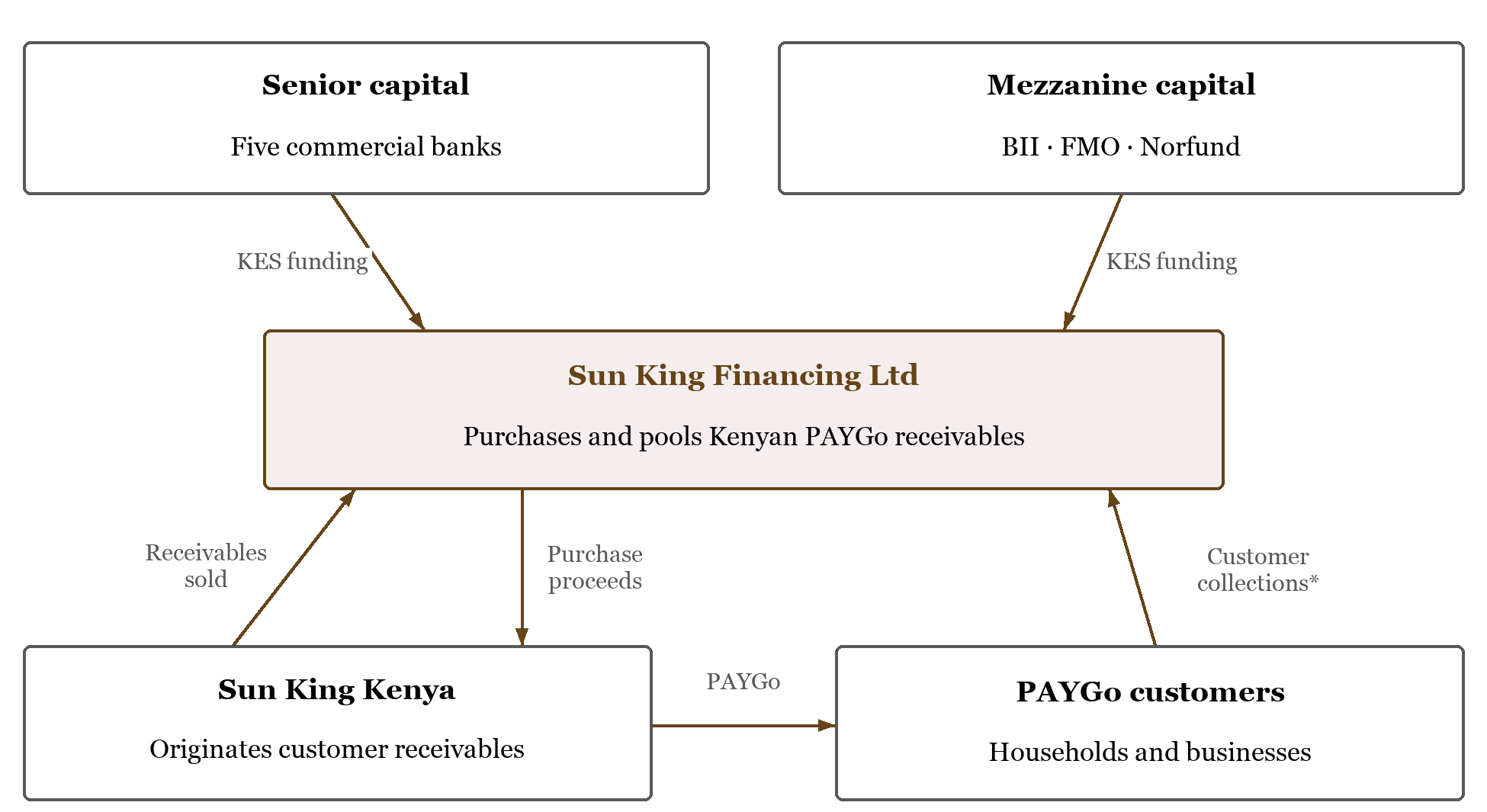
Public anchor: Sun King, Kenya, closed July 2025, KES20.1bn. *Customer collections economically underpin debt service; routing is simplified, not a direct collection-account assertion. Debt-service priority, tranche sizes, rating grades, pricing and advance rates are not reconstructed. This is a public-function schematic, not a legal waterfall.12, 13
Use development finance as a catalyst
Development finance institutions have scarce balance sheets. In the right transaction, a partial guarantee, subordinated tranche, first-loss facility, political-risk cover, liquidity reserve or project-preparation grant can change the risk-return profile enough to attract additional commercial capital. The value lies in the risk actually addressed—not in the size of the announced multiplier.
This is not an argument for indiscriminate de-risking or the socialisation of private losses. Catalytic support should address identifiable market failures, preserve commercial discipline and be priced and governed transparently. Reported volumes should be tested for additionality: what private financing entered, on what terms, because the intervention existed?
Achieved commitments provide a more useful test than targets. The global SDG Loan Fund closed fundraising in 2023 with US$1 billion of private institutional commitments against US$111.11 million of FMO first-loss capital: approximately 9:1. A US$25 million unfunded MacArthur guarantee supports FMO’s exposure. The multiple therefore cannot be attributed to FMO alone or read as fully disbursed capital.15, 16
BII’s 2025 institution-wide core measure reports approximately US$0.70 of private mobilisation per US$1 of its own commitments, using OECD methodology. A specially structured fund’s 9:1 result is not a general DFI benchmark. Both examples measure commitments, have different scopes and are not Africa-only. No matched Africa-only ratio of disbursed private capital to corresponding disbursed DFI capital was verified in this review.17
Exhibit 3. Mobilisation ratios need a defined numerator and denominator
| Evidence | Numerator / denominator | Interpretation |
|---|---|---|
| SDG Loan Fund 2023 close | US$1,000m private commitments / US$111.11m FMO first loss ≈ 9.0x | Global closed-fund commitments; separate US$25m unfunded guarantee. Not a disbursement ratio. |
| BII 2025 core measure | US$1.7bn private mobilisation / US$2.4bn gross commitments ≈ 0.70x (reported) | Institution-wide OECD core/transaction measure. Wider pilot mobilisation is excluded. |
| South Africa CGV / wider platform | US$500m planned CGV initial capital; ~US$10bn ten-year wider-programme target | Different scopes and prospective figures. Do not divide them into a realised “20x” ratio. |
These are not like-for-like performance measures. Fundraising commitments, disbursements, investment returns, guarantees and programme targets are distinct. A guarantee’s face value is contingent exposure—not funded equity or expected fiscal loss.15, 16, 17, 18
South Africa’s Credit Guarantee Vehicle illustrates the intended direction, not a demonstrated outcome. The World Bank’s March 2026 factsheet envisaged US$500 million of initial CGV capital and assigned the roughly US$10 billion ten-year mobilisation expectation to the broader Blended Finance Platform programme. These remain prospective figures in this article: no primary-source mobilisation performance data were located in this review. Approvals, expected subscriptions and targets are not evidence of funded capital or issued guarantees.18
Match African-currency cash flows with African-currency liabilities
Foreign-currency debt can appear inexpensive at origination and become punishing after depreciation. When a project earns Kenyan shillings but owes US dollars, it is effectively short dollars for the life of the debt. Unless revenues are indexed, hedging is available, or the balance sheet can absorb the volatility, the financing structure transfers macroeconomic risk into operating cash flow.
Consider the first year of an illustrative US$1 million loan: 8% interest on the opening balance and US$200,000 principal repayment produce US$280,000 of debt service. Assume cash available for debt service (CFADS) of KES54.6 million after operating costs, cash taxes, working-capital movements and required maintenance capital expenditure. Only the exchange rate changes.
Exhibit 4. Unchanged operations, weaker debt-service cover
| Illustrative first-year metric | Base case | Currency stress |
|---|---|---|
| KES per US dollar | 130.00 | 162.50 |
| USD debt service | 280,000 | 280,000 |
| KES interest (million) | 10.4 | 13.0 |
| KES principal (million) | 26.0 | 32.5 |
| KES total debt service (million) | 36.4 | 45.5 |
| KES CFADS (million) | 54.6 | 54.6 |
| DSCR = CFADS / debt service | 1.50x | 1.20x |
| Cash after debt service (KESm) | 18.2 | 9.1 |
Author illustration; not a forecast, current exchange-rate quote or loan-pricing offer. The shilling loses 20% of its US-dollar value: 130 / 162.50 = 0.80. KES/USD therefore rises 25%, not 20%. Interest and principal are fixed for this first-year comparison; no hedge, revenue indexation, reserve release, refinancing or operating response is assumed.
With no change in the assumed business cash generation, shilling debt service rises 25%, DSCR falls from 1.50x to 1.20x and cash after debt service halves. That residual is before distributions and any other obligations; 1.20x is not itself a universal covenant-breach threshold. In practice, depreciation may also affect imported costs, prices and working capital.
The principle is not “local currency at any price.” Local-currency borrowing removes the direct mismatch only to the extent payments are genuinely local-currency obligations. Its interest rate, resets, fees, tenor and refinancing risks still matter. The World Bank identifies local-currency finance, credit enhancement, risk sharing and pooled vehicles as complementary ways to mobilise domestic savings. The FX illustration does not assume a comparable shilling loan would carry the same price.19
Acorn’s student-housing bond provides a complementary precedent. In 2019, the issuer raised KES4.3 billion under a KES5 billion note programme. GuarantCo covered 50% of principal and interest; EAIF anchored the issue with KES1.279 billion. Acorn’s 2025 public presentation reports full programme redemption in September 2024. This is a structure with reported repayment, not merely a mobilisation target. It is not proof that the guarantee eliminated construction, property or collection risk.20, 21
Exhibit 5. A partially guaranteed local-currency bond
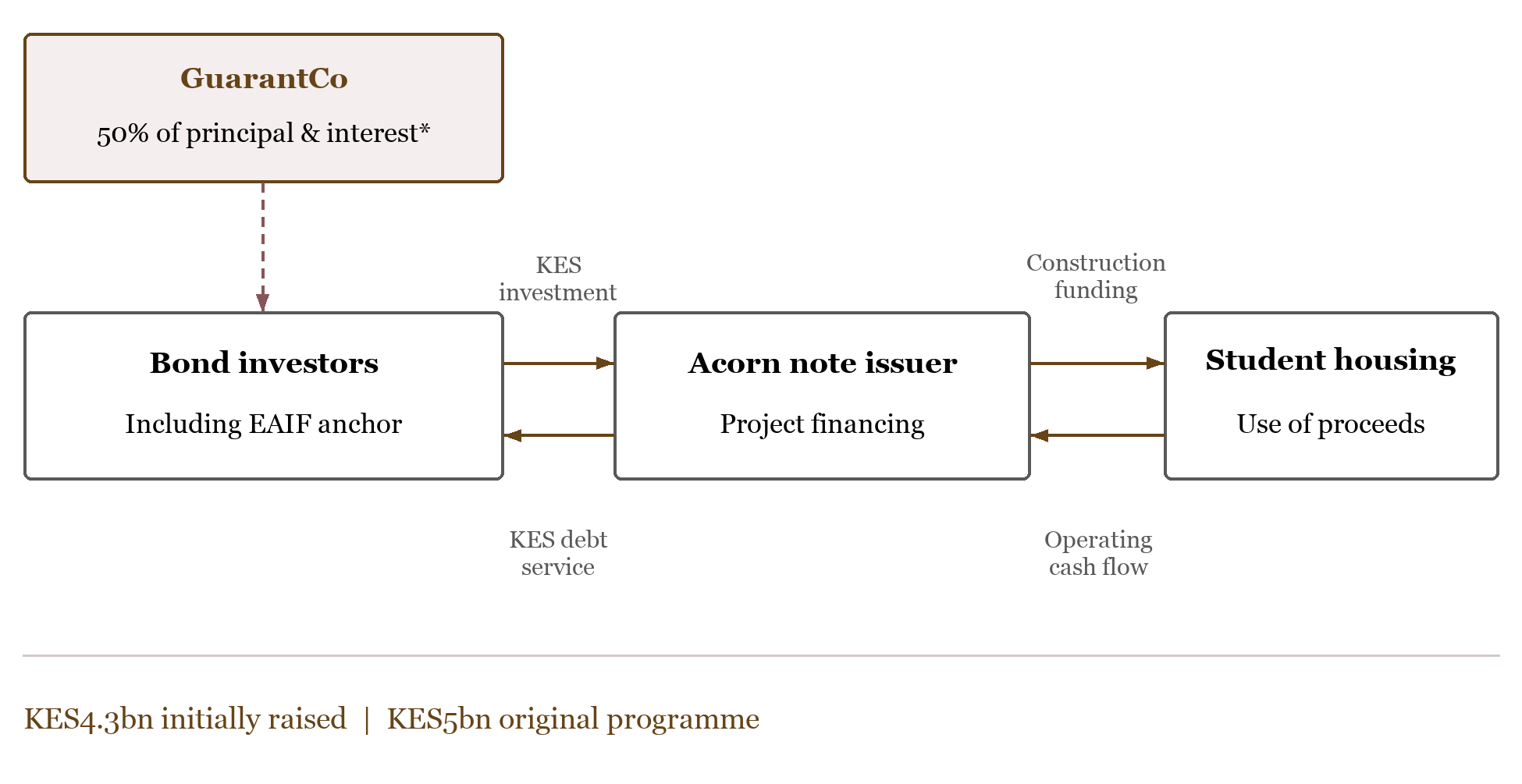
*GuarantCo’s disclosed coverage is a partial credit guarantee, not a 50% first-loss tranche or upfront cash injection. Claims depend on the transaction documents. Arrows show economic functions, not account-control arrangements or a contractual waterfall. Investors retain unguaranteed and other risks. Original 2019 raise and programme ceiling are shown; later programme expansion is not conflated with them.20, 21
The commercial lesson is that a local-currency bond can combine an anchor investor, partial credit support and a defined asset-financing purpose. But total issuance divided by guarantee face value would measure coverage leverage, not attributable private mobilisation. The EAIF participation also means the entire raise cannot be described as private capital.
Domestic capital first does not mean foreign capital out
A domestic-capital thesis should not become financial nationalism. Local institutions, DFIs, international funds and strategic investors each have different comparative advantages. The objective is to assign risks to the investors most capable of underwriting them.
Pensions and life insurers can be natural holders of eligible long-duration local-currency risk; banks can fund warehouses and term loans where their own funding permits. DFIs can provide targeted risk mitigation, subordinated capital and standards. International infrastructure funds, private-credit investors and strategic capital can add scale and specialist underwriting. Gulf investors may participate where mandates and commercial terms align. Foreign investment remains important alongside domestic capital—not as its substitute.
The missing profession is transaction architecture
Policy debate often traces a simple chain: savings flow into financial institutions, which then fund productive assets. The least examined step is the one in the middle: who manufactures the instrument that allows the institution to own the asset?
That work belongs to sponsors, investment banks, arrangers, guarantors, DFIs, regulators and specialist advisers. It requires more than financial modelling. It requires contractual standardisation, portfolio data, enforceable security, credible servicing, governance, reporting, ratings where useful, bankruptcy remoteness where necessary, and documentation that allocates rather than obscures risk.
This is especially important for operating companies crossing from venture-backed growth into infrastructure credit. The transition does not occur because management changes the label on a pitch deck. It occurs when the business establishes a record of contractual cash flows, asset security, segmented financial reporting, credit metrics, institutional governance and a financing structure that separates operating-company risk from asset-level risk.
Structure cannot rescue weak economics
The counterargument is important. Some projects lack capital because tariffs, utilisation, costs or counterparties do not support commercial returns. Others face policy uncertainty, weak enforcement, limited domestic savings or markets too shallow to provide affordable long-term finance. Better documentation cannot cure those problems. Some socially valuable projects need explicit, sustainable public support; that is a funding decision, not value created by financial engineering.
Structures have costs and limits. Securitisation can concentrate dependence in a servicer and leave systemic risks intact. Guarantees transfer defined risks to another balance sheet, potentially the public sector; coverage, exclusions, claims timing and fiscal exposure matter. Project preparation, policy reform and macroeconomic discipline remain essential. Investability is one part of the problem, most useful where a sound asset is held back by an unsuitable instrument.
Capital formation, not capital chasing
Africa’s financing challenge will not be solved by declarations of investor appetite or instructions to pension funds to increase allocations. Institutions still need securities that fit their mandates, credible evidence of repayment capacity and returns that compensate for risk. Eligibility is necessary, not sufficient: an eligible instrument can still be unattractive or compete with better opportunities.
The opportunity is to expand the set of viable assets that institutions can finance: prepare projects properly, aggregate exposures where it improves economics, make cash flows and risks transparent, and match instruments with investors able to hold them. Capital formation will not replace new savings, foreign investment or policy reform. It can make each more effective.
That is capital formation, not simply capital chasing. Africa does not only need more capital. It also needs more viable assets translated into investments that institutions can own.
Selected investor-rule evidence
Public regulatory texts reviewed on 2 September 2026. This is a selected comparison, not legal advice, a full compliance checklist or confirmation of transaction eligibility. Percentages must be applied to the stated investor, fund, asset category and denominator. Ceilings cannot be summed or multiplied by aggregate African assets to infer deployable capital.
Pension and retirement investors
| Investor / scope | Selected allocation and concentration tests | Eligibility, liquidity and qualifications |
|---|---|---|
| Kenya Published RBA categories; occupational scheme example | Listed corporate debt: 20%; nonlisted private-company debt: 10%. Occupational quoted single-company equity: 15%; specified sponsor-related unquoted equity and debt: 3%. Base: aggregate market value of relevant scheme/pooled-fund assets. 8, 22 | Nonlisted private-company debt must be investment grade from a CMA-registered agency. Policy addresses realisation and asset–liability matching. Scheme-category rules differ; equity limits are not debt issuer caps. 8, 22 |
| Nigeria RSA Funds II and III | Fund II: corporate debt 40%, infrastructure-bond sublimit 30%; infrastructure funds 20% (7.5% of portfolio per issuer; 25% of underlying fund value). Fund III: corporate debt 45%, infrastructure-bond sublimit 25%; infrastructure funds 0%. 9 | Sublimits are percentages of the relevant RSA portfolio. General debt rating A, with a bounded BBB exception; instrument-specific conditions apply. Infrastructure bonds need specified guarantees; infrastructure funds need predefined exits. 2026 addendum changes equity limits, not these figures. 7, 9 |
| South Africa Regulation 28 retirement funds | Base: aggregate fair value of total fund assets. Infrastructure 45% across asset classes; entity 25%, with specified sovereign exclusions. Residual other debt: unlisted 15% aggregate / 5% issuer. 10 | Not a prescribed allocation or an extra 45% asset category. Instrument classification and trustee duties still govern. No blanket investment-grade minimum is asserted. Public schemes require scope checks. 10 |
| Morocco Private-law retirement bodies only | Specified sovereign/guaranteed basket: 35% minimum. Issuer ceilings generally 12.5% for specified issuers, 5% otherwise; FPCT/OPCC: 1% per security / issuer. 11 | Assets representing technical provisions are the base. Article 7 requires liquidity, security, diversification and liability-duration fit. No universal rating floor verified. Do not extend these rules to all public pension schemes. 11 |
FPCT: Moroccan securitisation vehicles. OPCC: Moroccan collective capital-investment vehicles. A guarantee may improve a credit case without removing asset-class, issuer, liquidity or investor-specific restrictions.
Insurance investors: a different rulebook
| Investor / source scope | Selected investment or concentration evidence | Credit quality, liquidity and source limitation |
|---|---|---|
| Kenya Investment-management and capital-adequacy guidelines | Concentration factors for capital adequacy: deposits in one institution/group 10% of total assets; shares of one institution/group 10%. Excess concentrations are inadmissible for capital calculation. 23, 24 | These are capital-adequacy treatments, not unrestricted investment permissions. Investment policy must address liquidity, liabilities and ALM. No universal bond-rating floor is inferred. 23, 24 |
| Nigeria Dated October 2022 NAICOM guidelines | Policyholder funds: corporate debt including infrastructure bonds/ABS, 10% aggregate / 5% issuer, subject to prior-approval exceptions. Shareholder funds: SEC-registered infrastructure funds 10% / 5% issuer, with Commission approval. 25 | Different pools and denominators. Liquidity reports compare inflows/outflows and contingency plans. NIIRA 2025 saves instruments in force at commencement, subject to the new Act. Later circulars/current limits require confirmation before reliance. 25, 26 |
| South Africa Prudential Authority explanatory evidence | Do not import Regulation 28 pension ceilings. Credit Quality Steps affect default, spread and concentration capital. No universal insurer infrastructure cap is asserted here. 27 | PA liquidity guidance calls for stress testing, maturity-gap/counterparty limits and liquid-asset planning. Guidance and supervisory observations are not independent allocation law. No draft numeric HQLA rule is treated as effective. 27, 28, 30 |
| Morocco Direct insurers’ technical provisions | Combined FPCT/OPCC allowance 10% of technical provisions. FPCT/OPCC concentration: 2.5% per security/issuer on the adjusted representative-asset base; other issuer ceilings vary. 29 | Unlisted subordinated bonds without AMMC visa are inadmissible, subject to the specified bank-bond exception. Visa is not a credit rating. Solvency reporting includes liquidity stress. Unit-linked provisions have separate treatment. 29 |
Research limitation: retrieved public texts establish these selected distinctions, not that no later amendment, exemption or tighter investor mandate exists. Nigeria’s insurance figures are retained as explicitly dated guideline evidence. Morocco is scheme-specific. Ratings, listing, regulatory approval and investor credit judgement are separate tests.
Sources and measurement notes
Public sources accessed 2 September 2026. Article transaction facts are reported by the named institutions; schematics simplify their functions. FX outputs are author calculations from explicitly hypothetical inputs. Mobilisation results are commitment-based unless expressly stated otherwise. No private transaction documents were used.
- AfDB — Africa Private Capital Mobilisation Day opening remarks. 17 Dec 2025; annual development gap, not an energy-only gap.
- OECD — Africa Capital Markets Report 2025, Corporate Debt Markets. Section 3.2.2; cites AFC 2025 for the approximately US$1.1tn stock.
- AFC — Africa strengthens foundations to lead its own financing. 23 Apr 2026, “Local Capital on the Rise”; broader, mixed-date non-bank pool.
- IMF — Revised Guidelines for Foreign Exchange Reserve Management. 2014 edition, paras.5, 8–11 and 44; reserve availability, liquidity and risk.
- Basel Committee — LCR20, Calculation. Para.20.1; 30-day stress principle. Not a claim of uniform national adoption.
- IFSWF — Santiago Principles. GAPP 3–4 commentary; different savings/stabilisation mandates and horizons.
- PenCom — Addendum to revised pension investment regulations. 9 Feb 2026, paras.1–3; diagnosis of instrument shortage and selected equity-limit changes.
- Kenya RBA — Investment Guidelines. Current regulator webpage, items 3–4. Percentages use aggregate market value of scheme/pooled-fund assets.
- PenCom — Revised Regulation on Investment of Pension Fund Assets. Sep 2025, sections 6.1.2–6.1.3, 6.2.4 and 9; printed pp.18, 25–26, 53–56, 59–61.
- South African National Treasury — Published Regulation 28 amendments. Gazette 46649, 1 Jul 2022, effective 3 Jan 2023; Reg.28(3)(h)/(iA), Table 1 items 2.1(e), 9, 11.
- ACAPS — Circular 3/PS/19, private-law retirement bodies. 4 Mar 2019, amended 6 May 2021; arts.7–10, PDF pp.5–7.
- Citi — US$156m Sun King securitisation. 28 Jul 2025, deal description and participant/tranche disclosure. Majority commercial-bank-backed; exact tranche sizes not supplied.
- FMO — Sun King Financing Limited, project 64805. Published 2 May 2025; effective 18 Jul 2025. Customer and funding-objective sections describe SPV receivables purchases.
- Citi — Perspectives for the Public Sector 2026. Page 26, “Energy Access in Africa”; revolving securitisation facilities.
- FMO — SDG Loan Fund, project 62975. Capital structure; US$111.11m FMO commitment and US$1bn Class A capital, with unfunded US$25m MacArthur guarantee.
- FMO — SDG Loan Fund mobilises US$1.1bn of investor capital. 28 Nov 2023; fundraising close. 1,000 / 111.11 ≈ 9.0x private/FMO commitments. Guarantee wraps FMO exposure and is not added as a funded tranche.
- BII — Annual Review 2025, Investments. “Mobilising commercial capital”; reported core ratio US$70 private per US$100 own commitments. US$3.1bn wider pilot measure excluded.
- World Bank — South Africa’s Credit Guarantee Vehicle. 5 Mar 2026; planned US$500m initial capital, including expected DFI subscriptions; ~US$10bn belongs to broader ten-year programme.
- World Bank / PPIAF — Unlocking Local Finance for Sustainable Infrastructure. 2024; local currency, credit enhancement, risk-sharing and pooled finance.
- GuarantCo — Partial credit guarantee for Acorn’s KES5bn note programme. Oct 2019; initial KES4.3bn raised, 50% principal/interest coverage and KES1.279bn EAIF participation.
- Acorn Holdings — AUHF blended-finance presentation. Oct 2025, printed pp.16–17; issuer reports programme fully redeemed Sep 2024. Later expansion is separate from original raise.
- Kenya Law — Retirement Benefits (Occupational Schemes) Regulations. Displayed consolidation 25 Jul 2025; regs.37(2)(b), 38(1)(c)–(d). Sponsor/quoted-equity limits are scheme-specific.
- Kenya Law — Insurance (Investments Management) Guidelines. Legal Notice 45/2017; displayed consolidation 31 Dec 2022; paras.3, 12 and 15.
- Kenya Law — Insurance (Capital Adequacy) Guidelines. Legal Notice 39/2017; paras.9(d), 10. Concentration treatment is for capital admissibility.
- NAICOM — Revised Prudential Guidelines for Insurance Institutions. Oct 2022; sections 3.8.3–3.8.4 and 6.3.3.4, printed pp.16, 18, 41. Official indexed text; direct download restricted. Later amendments require confirmation.
- Nigeria — Nigerian Insurance Industry Reform Act 2025, gazetted text. Sections 229–230, Gazette p.A861; savings of prior instruments subject to conflict. Not proof that no subsequent circular changed a limit.
- South African Prudential Authority — FSI Technical Supervisory Observation, Topic 3. 2024 official publication, pp.2–3; Credit Quality Steps. Explanatory observation has no independent legal standing.
- South African Prudential Authority — Guidance Notice 1 of 2022. 24 Nov 2022; sections 3.8, 5, 8.3 and 8.6. Liquidity guidance, not an independent allocation schedule.
- ACAPS — Consolidated Circular 01/AS/19 implementing the Insurance Code. 2 Jan 2019, regulator copy hosted Nov 2024; arts.42, 49–50, 54, 77; printed pp.23, 25–27, 40; relevant amendments 2021/2023.
- South African Prudential Authority — Regulatory Strategy 2025–2030. Progress Oct 2021–Mar 2025 confirms issuance of Guidance Notice 1/2022.