Rwanda’s EV Charging Rules: A New East African Regulatory Benchmark
RURA’s June 2026 rules establish per-site licensing, technical standards and service obligations for public charging and battery swapping. They provide a useful regional benchmark—but not a forecast—for underwriting operators in Ethiopia, Uganda and Kenya.
In brief
- Rwanda’s June 2026 rules place commercial public charging and charging battery-swap sites under a binding licensing regime. Existing operators have twelve months to comply.
- The regime introduces five-year per-site licences, technical requirements for public charging stations and enforceable service standards, including 97% charger uptime.
- Article 22 weakens the underwriting case for permanently closed battery ecosystems, but rider transition remains subject to contractual settlement and a two-year implementation period.
- For Rwanda projects, compliance expenditure and renewal risk should enter base-case models now. Elsewhere, operators should preserve technical optionality without assuming Rwanda’s specifications will be copied verbatim.
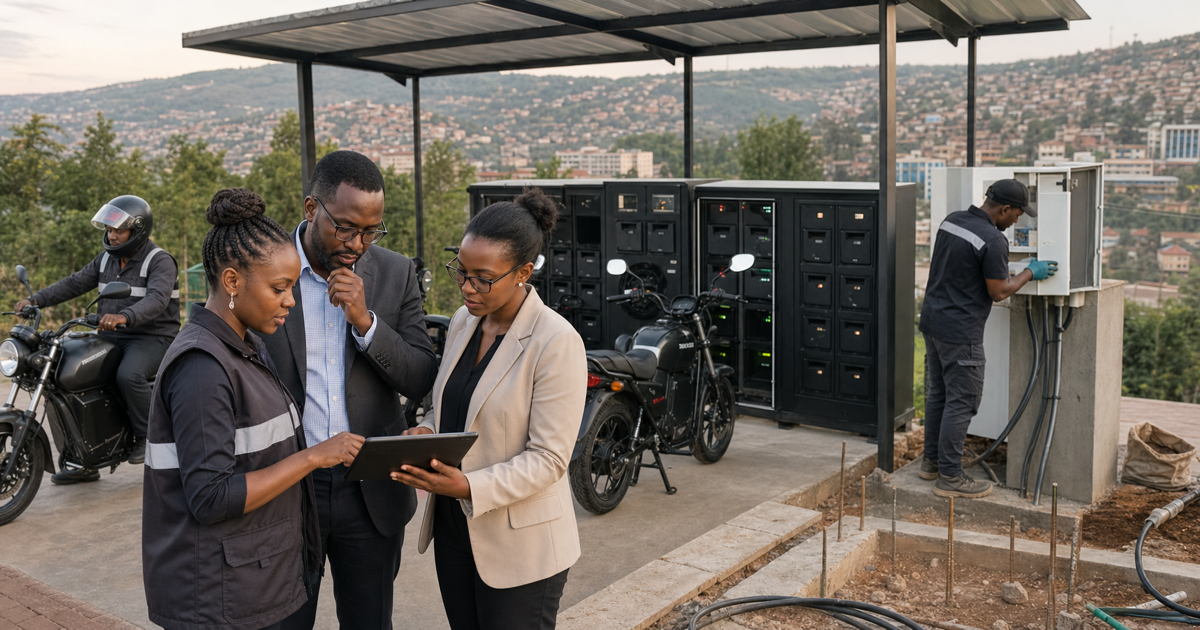
On 29 June 2026, the Rwanda Utilities Regulatory Authority issued Regulations No 011/ENERGY/RURA/2026 governing electric-vehicle charging infrastructure and battery swapping stations. The rules came into force on signature. Operators already active in the market have no more than twelve months to comply.1
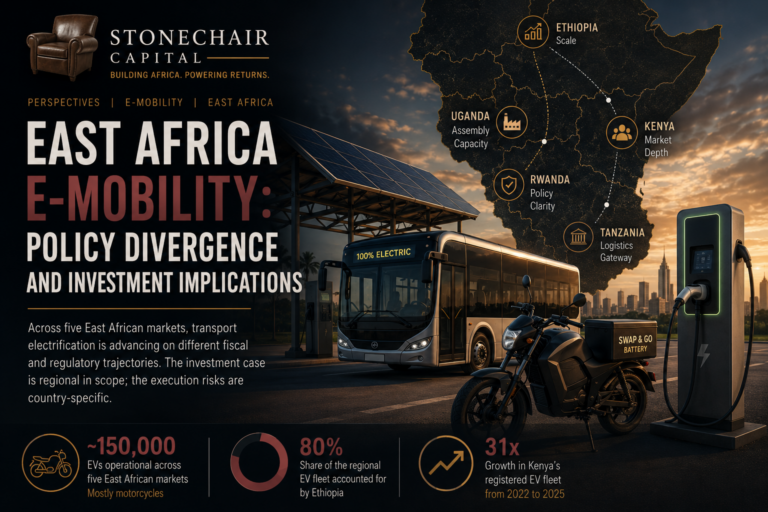
This is a binding licensing instrument rather than a strategy statement. It specifies site-level licensing, technical standards and service obligations for public charging and charging battery swapping. For investors, it provides a concrete diligence benchmark. It does not establish that Ethiopia, Uganda or Kenya will adopt identical specifications or follow the same policy sequence. This article is a regulatory follow-on to Stonechair’s May 2026 review of East African e-mobility investment implications.
97%
Minimum charger uptime required around the clock under Article 26
50 kW
Minimum output per DC charging gun for at least one system at a public station under Annex I
5 years
Per-site licence tenor under Article 19
Rwanda’s pathway to binding rules
Rwanda’s framework developed through a series of measures: a 2019 pilot; an incentive strategy in 2021; a Kigali registration restriction announced for public-transport motorcycles; a dedicated high-consumption charging tariff in 2025; and binding rules in 2026. The chronology is commercially relevant because demand-side measures and an electricity-price framework preceded the licensing obligations. It should nevertheless be treated as Rwanda’s pathway, not as a regional template.
| Date | Measure | Underwriting relevance |
|---|---|---|
| Oct 2019 | Volkswagen and Siemens launched a four-vehicle pilot and one charging station, described by the project partners as a first for the continent.4 | Demonstration phase; limited evidence of commercial utilisation. |
| Apr 2021 | MININFRA’s strategic paper set out fiscal incentives, access to government land and an industrial-rate objective for public charging.2 | Policy intent established; implementation and eligibility still required verification. |
| Nov 2024 | The government announced that Kigali would stop new registrations of petrol-powered public-transport motorcycles from January 2025.5 | Demand-side restriction focused on a specific city and vehicle use case. |
| Oct 2025 | A tariff category of FRW 110/kWh took effect for public charging infrastructure consuming at least 660,000 kWh annually, excluding VAT and regulatory fees.3 | Defined energy price for qualifying high-load sites; smaller sites cannot assume eligibility. |
| Jun 2026 | RURA’s charging and battery-swapping regulations entered into force.1 | Licensing, technical, service and enforcement obligations became binding. |
The 2025 tariff gives qualifying high-load public charging sites a defined electricity price. The consumption threshold is approximately 55,000 kWh a month, and the published rate excludes VAT and regulatory fees. Smaller networks should therefore not place the headline FRW 110/kWh rate into base-case economics without confirming eligibility. The subsequent regulation improves visibility on licensing and operating obligations, but the order of the two measures does not prove that neighbouring markets will follow the same sequence.
Regional read-through
Ethiopia: demand intervention before a settled framework
Ethiopia’s policy intervention was driven in part by foreign-exchange and fuel-import pressure. The International Energy Agency records a national prohibition on imports of internal-combustion vehicles from January 2024.6 The jointly prepared Ethiopian Energy Outlook 2025, however, describes an effective administrative restriction based on foreign-currency allocation and import-tax treatment rather than a formal statutory prohibition.7 That distinction matters because the durability and reversal process may differ.
Published sources also diverge on 2024 EV tax treatment. The Outlook reports that 15% VAT was introduced and customs duties reduced to 5%. The IEA’s April 2026 update says fully built electric vehicles moved from a 15% to a 20% customs duty, while partially assembled vehicles retained different treatment and VAT exemptions.8 Applicable rates should therefore be verified by vehicle configuration, HS classification and assembly status before entering an investment model.
Ethiopia announced a charging directive in January 2025 covering licensing, service tariffs, power-supply standards and security, with proposed highway spacing of 50 km for standard vehicles and 120 km for heavy vehicles.9 Published fleet estimates have varied widely. Utilisation cases should be built from operator, utility and registration data that can be reconciled to a common vehicle category and date.
Uganda: scale and industrial policy, but no comparable binding regime
Uganda’s electric two-wheeler market expanded sharply in 2025. The IEA reports sales above 30,000 units, compared with more than 25,000 in Kenya and approximately 70,000 across Africa.10 This supports the demand case, but it does not establish the utilisation or profitability of any individual swapping network.
Uganda’s National E-Mobility Strategy targets at least 3,500 public charging stations and more than 10,000 fast chargers by 2040, together with charging infrastructure at public offices by 2030.11 These are policy targets rather than contracted demand or binding deployment obligations. In the instruments reviewed for this article, Stonechair did not identify a Rwandan-style regime with per-site licensing, 97% uptime and specified administrative sanctions.
Published network counts are not sufficiently comparable to support country-level utilisation ratios: available figures mix operator networks with national totals and use different dates and definitions. Station density should be treated as an operator-level diligence question—supported by battery turns, uptime, cohort retention and revenue per site—rather than inferred from headline country counts.
Kenya: tariff and policy in place; obligations remain less prescriptive
Kenya implemented a dedicated e-mobility electricity tariff in July 2023 at KSh 16/kWh during peak hours and KSh 8/kWh off-peak. Kenya Power reported KSh 382 million of cumulative e-mobility revenue between July 2023 and April 2026, with 331 customers metered on the tariff by June 2026.12 These utility data are more useful for demand analysis than headline charging-point counts, but they still require separation by vehicle type, site and customer cohort.
EPRA’s September 2023 guidelines require an electricity retail-supply licence for public charging stations and set equipment, safety and network-planning requirements.13 Kenya then launched a National Electric Mobility Policy in February 2026.14 The instruments reviewed do not impose the same site-specific service and penalty regime as Rwanda’s 2026 regulations.
Current market totals also require reconciliation. The transport ministry reported 39,324 cumulative EV registrations at the end of 2025,14 while Kenya Power referred to more than 35,000.12 The 2025 National Energy Compact separately recorded approximately 137 charging and swapping installations and a government objective of 10,000 charging stations by 2030.15 The differences are manageable for market commentary but too material for site-level utilisation forecasts without source-level reconciliation.
| Market | Charging framework | Price framework | Principal diligence issue |
|---|---|---|---|
| Rwanda | Binding 2026 regulations; per-site licensing for specified commercial activities | FRW 110/kWh for qualifying public infrastructure using at least 660,000 kWh a year; taxes and regulatory fees excluded | Compliance expenditure, interoperability, tariff eligibility and five-year renewal risk |
| Ethiopia | Import restriction and a charging directive announced in January 2025 | Operator charging prices addressed by the directive; published tax treatment conflicts | Legal implementation, applicable tax classification and fleet-data reliability |
| Uganda | National strategy and infrastructure targets; no comparable per-site regime identified in this review | No dedicated national charging tariff identified in the sources reviewed | Site utilisation, funded rollout and transition from policy targets to enforceable instruments |
| Kenya | 2023 EPRA guidelines plus the February 2026 National Electric Mobility Policy | KSh 16/kWh peak and KSh 8/kWh off-peak | Reconciled registrations, charging demand by segment and the timing of more prescriptive rules |
What Rwanda’s regime changes for operators
Five provisions carry the greatest commercial weight.
- Interoperability—Article 22 Electric motorcycles must be technically compatible with approved battery-swapping systems, and riders may transition between licensed operators after settling outstanding contractual, financial and operational obligations. Existing operators and supply-chain participants have two years to comply. This weakens the underwriting case for permanent captive-network economics. It does not establish that batteries are physically interchangeable across every network today; technical standards, implementation and commercial settlement will determine the extent and timing of interoperability.
- Service levels—Article 26 Licensees must maintain 97% charger uptime around the clock, limit repair time to 24 hours, keep replacement spares available and cap battery-swap waiting time at 20 minutes. Customer complaints are generally subject to a 24-hour resolution period, with an exception for matters requiring technical investigation if the customer is given a status and expected timeline. These obligations translate directly into maintenance capacity, staffing and spare-parts working capital.
- Technical requirements—Annex I A public EV charging station must include at least one DC fast-charging system rated at a minimum of 50 kW per charging gun and support at least two prevalent charging technologies. Annex I also sets power-quality, protection, metering and environmental requirements. These requirements apply to Rwanda’s public charging stations; they should not be imported unchanged into a battery-swap or neighbouring-market model.
- Pricing oversight—Article 27 RURA requires pricing to be fair, transparent, non-discriminatory and reflective of market conditions and operating costs, and retains the power to intervene. This creates pricing and consumer-protection oversight, but it is not equivalent to ex ante tariff approval or a fixed retail-margin cap.
- Licence tenor and renewal—Articles 4, 19 and 20 Relevant commercial licences are issued per site for five years and normally lapse if operations do not commence within six months. Renewal applications are due at least 180 days before expiry and are subject to a business-viability assessment based on audited financial statements, as well as safety and security compliance. Where charger and civil-works lives exceed the licence term, lenders must address renewal risk, refinancing exposure and residual value.
RURA currently charges no application or licence fee, but licensees remain subject to turnover-based regulatory charges and to ordinary permitting, grid-connection and compliance costs. Article 36 applies a FRW 1 million fine to specified licensing and operational offences—not every breach—while separate technical and safety sanctions may apply. Suspension, revocation or delayed renewal may represent a more material downside than the stated administrative fine.1
Underwrite Rwanda now; preserve optionality elsewhere
Regional market data are too inconsistent to support a single current fleet baseline. Published figures use different vehicle categories, registration definitions and reporting dates. For underwriting, the relevant measures are site-level demand, energy throughput or battery turns, revenue per asset, uptime, fleet retention and tariff eligibility.
Rwanda’s rules improve clarity on permitted activity, technical standards and operating obligations. That visibility may support financing, but regulation alone does not make a project bankable. Utilisation, grid-connection cost, licence renewal, sponsor capacity and downside recovery values remain decisive. The same rules may increase capital expenditure, spare-parts requirements and operating costs while weakening assumptions based on captive ecosystems.
The four markets should therefore be treated as distinct regulatory cases, not as stages of a common sequence. Rwanda now provides the clearest binding benchmark reviewed here; Ethiopia has used an import restriction and charging directive; Uganda combines rapid two-wheeler growth with industrial-policy targets; and Kenya has a dedicated tariff, guidelines and national policy. Convergence is possible, but neither timing nor specification should be assumed.
For Rwanda, operators and lenders should re-underwrite interoperability, service levels, renewal risk, tariff eligibility and compliance expenditure now. Elsewhere, the prudent response is to preserve optionality through modular electrical design, standards flexibility, spare-parts planning and credible migration pathways. Rwanda’s 50 kW and 97% thresholds should not enter another market’s base case without evidence that the local regulator—and the relevant vehicle mix—will require them.
Key terms
- Battery swapping
- Exchanging a depleted battery for a charged one rather than waiting to recharge. The model is widely used by commercial electric-motorcycle fleets in East Africa.
- Interoperability
- The technical, operational and commercial ability to use charging or swapping services across operators. Under Rwanda’s rules, rider transition remains subject to contractual settlement and standards implementation.
- Power factor and total harmonic distortion
- Measures of electrical power quality. The Rwandan rules set minimum performance thresholds to limit adverse effects on the grid.
Sources
- Regulations No 011/ENERGY/RURA/2026 — Rwanda Utilities Regulatory Authority.
- Strategic Paper for E-Mobility Adaptation in Rwanda — Ministry of Infrastructure, April 2021.
- Electricity end-user tariff effective 1 October 2025 — Rwanda Energy Group.
- Volkswagen and Siemens launch joint electric-mobility pilot project in Rwanda — Siemens, 29 October 2019.
- Rwanda to halt registration of petrol motorcycles in 2025 — The New Times, November 2024.
- Ban on imports of internal-combustion-engine vehicles — IEA Policies Database.
- Ethiopian Energy Outlook 2025 — Ministry of Water and Energy and partners.
- Tax reform for electric vehicles in Ethiopia — IEA Policies Database, updated 28 April 2026.
- Ethiopia announces plan to expand electric-vehicle charging infrastructure — Xinhua, 13 January 2025.
- Trends in other EV modes — IEA, Global EV Outlook 2026.
- National E-Mobility Strategy — Republic of Uganda.
- Kenya Power kicks off customer transition to e-mobility tariff — Kenya Power, 4 June 2026.
- Electric Vehicle Charging and Battery Swapping Infrastructure Guidelines — EPRA, September 2023.
- Kenya launches National Electric Mobility Policy — Ministry of Roads and Transport, 3 February 2026.
- Kenya National Energy Compact — Ministry of Energy and Petroleum, August 2025.
Stonechair Capital Stonechair Capital advises and co-invests alongside energy and mobility infrastructure projects across Africa.
Contact the firm#EnergyAfrica
This article is prepared by Stonechair Capital for informational purposes only and does not constitute investment advice or a solicitation to buy or sell any security. Regulatory provisions should be verified with qualified local counsel before reliance. Where authoritative sources conflict, the conflict is identified rather than resolved through assumption.