
African Capital Markets: Financing Sustainable Transport at Scale
A new GIZ and Agora Verkehrswende report sets out twelve policy turning points for African transport. Its financing agenda depends on a pool of domestic capital that is large, institutional and, for the most part, not yet invested in infrastructure.
In brief
- The report estimates annual African infrastructure investment at about USD 80 billion against a requirement of USD 130–170 billion; transport alone needs USD 35–47 billion a year.[1]
- FSD Africa reports more than USD 600 billion across pension funds and other collective investment schemes. In many countries, government securities account for 60–70% of pension portfolios and under 10% reaches infrastructure, housing, private credit or SMEs.[3]
- Local-currency credit enhancement and listed infrastructure debt are beginning to connect pension capital to projects, at a scale that remains small relative to the asset base.[8][9]
- E-mobility fleet financing is still funded largely by development finance and venture capital. Refinancing operating fleets in local-currency capital markets is a logical next step, though no precedent was identified in the sources reviewed.[10]
The UN Decade of Sustainable Transport (2026–2035) has produced a clear statement of intent from African governments. In April 2026, African transport and energy ministers endorsed a Continental Framework on Electric Mobility. A companion report from GIZ and Agora Verkehrswende, Turning Points: Enabling Sustainable Transport in Africa, sets out twelve interventions intended to turn that framework into delivery.[1] The policy agenda is credible. The financing agenda is where it will be tested.
The report places annual infrastructure investment on the continent at about USD 80 billion in 2022, roughly half of the USD 130–170 billion required, with transport infrastructure alone needing USD 35–47 billion a year.[1] Three of its twelve turning points concern financing, and each points toward domestic sources: protected budget lines, regional pooled funds and national e-mobility credit systems. This article considers whether African capital markets can supply the institutional growth capital those turning points assume.
The capital exists but sits in sovereign debt
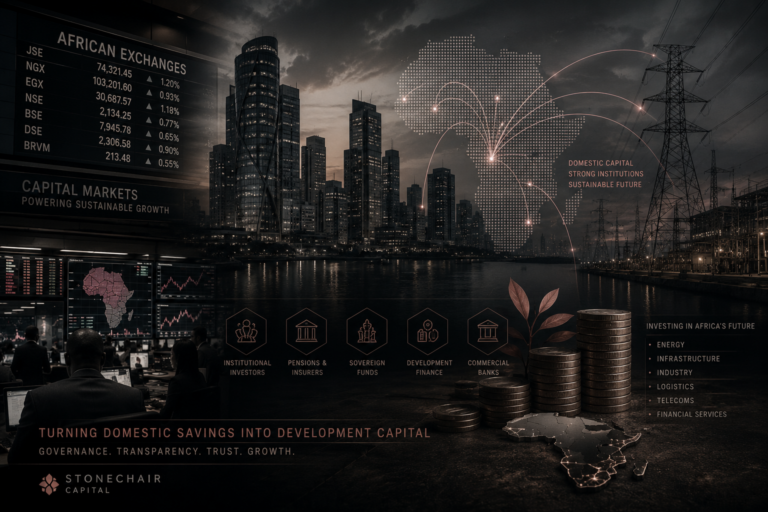
The chief executive of the Africa Finance Corporation (AFC) cited more than USD 4.4 trillion of investable domestic capital across pension funds, insurers and sovereign wealth funds at the South Africa Investment Conference in April 2026.[2] The figure is a headline estimate and the source does not itemise it. FSD Africa’s January 2026 release, accompanying the PAFMA landscape report, places pension funds and other collective investment schemes together at more than USD 600 billion. That aggregate should not be read as a pension-only total.[3]
| Market | Reported assets | Allocation to government securities |
|---|---|---|
| South Africa | About USD 390 billion | Not stated in source |
| Kenya | About USD 20 billion | About 50% |
| Nigeria | About USD 17 billion | About 60% |
| Ghana | Not stated in source | About 90% |
| Continental pool / allocation pattern | Over USD 600 billion (pension funds and other collective investment schemes) | 60–70% in many countries; not a weighted continental average |
Allocation, rather than volume, is the constraint. Government securities account for 60–70% of pension portfolios in many countries, and less than 10% reaches infrastructure, housing, private credit or SMEs in many markets.[3]
Sources diverge on the absolute figures. An earlier analysis from the African Financial Summit platform (published 2022, updated 2025) gave South Africa at USD 500 billion and Nigeria at USD 33 billion.[4] A separate account of an AFC presentation cited Nigeria’s pension industry at NGN 29.4 trillion in February 2026, attributed to the National Pension Commission, with about 60% in government debt and under 10% in corporate or productive assets.[5] The differences are likely to reflect dates, definitions and exchange-rate conversion, and none of the sources reconciles them. The allocation pattern is consistent across all of them.
Why the capital does not reach projects
Three structural factors recur in the sources.
Sovereign supply and pricing. Domestic debt often has short maturities, creating rollover risk. The IMF reports that the median sub-Saharan African country issued domestic debt at an average interest rate of 8.8% in 2024; real costs vary with inflation.[7] A pension fund can meet its liabilities from sovereign paper at those levels, so an infrastructure asset must compensate for construction risk, illiquidity and longer tenor against a high-yielding, liquid alternative. OMFIF describes secondary markets as dominated by buy-and-hold investors.[6]
Pipeline. The GIZ report cites an estimate that fewer than 10% of planned infrastructure projects on the continent reach financial close, and attributes much of this to the lack of technical capacity and dedicated budgets for project preparation.[1] The AFC puts the proportion of African infrastructure projects that fail at the development stage at roughly 90%.[5] The two figures measure different things but point in the same direction: investors face a shortage of well-prepared transactions rather than a shortage of money.
Mandate and capability. Pension managers frequently lack infrastructure expertise, face offshore investment limits and foreign-exchange risk, and find individual schemes too small to underwrite large projects.[4] That analysis dates from 2022 and regulatory positions have moved in some markets, notably pension reform in Nigeria and Kenya noted by OMFIF.[6] It remains a reasonable description of why allocations have been slow to change.
Instruments that are beginning to bridge the gap
Two recent examples show how pension capital can be connected to real assets without requiring pension funds to underwrite project risk directly.
InfraCredit in Nigeria provides local-currency guarantees on infrastructure bonds. As of 30 June 2026 it reported NGN 324.54 billion of guarantees outstanding across 27 counterparties and 28 projects that reached financial close, 20 pension fund investors, and a weighted average tenor of 7.68 years, with the longest at 20 years against 15 years for standard corporate infrastructure bonds.[8] Transportation, covering ports, toll roads and rail, is 5% of the portfolio and logistics a further 11%. InfraCredit reports an AAA rating. The mechanism is credit enhancement: the guarantee converts project credit into paper that a pension fund can hold within its mandate.
In Kenya, the Spearhead Africa Infrastructure Fund listed on the Nairobi Securities Exchange on 19 May 2026. It raised KES 3.4 billion, of which the UK-backed MOBILIST programme anchored KES 1.2 billion, to provide senior debt to private infrastructure in renewable energy, digital infrastructure, logistics and electrification.[9] Kenyan pension schemes manage more than KES 2.8 trillion, so the fund is equivalent to roughly 0.1% of that base.[9] The significance lies in the structure, a tradeable local-currency infrastructure debt instrument, more than in its current size.
Sovereign and sub-sovereign issuance adds to the picture. Tanzania’s Samia infrastructure bond was reported as raising more than 115% of its target, and Tanzania has issued a debut sovereign sukuk.[6] Nigeria’s third sovereign green-bond offer closed in June 2025 with NGN 91.42 billion in subscriptions against a NGN 50 billion offer; NGN 47.355 billion was allotted at an 18.95% annual coupon. Subscriptions demonstrate demand but should not be confused with proceeds raised.[12]
E-mobility as the test case
Electric mobility is the clearest test of whether this machinery can finance the report’s agenda. The GIZ report notes that e-mobility requires simultaneous investment in vehicles, charging and power systems, and that prohibitive costs of capital threaten mass adoption.[1]
BasiGo, the Nairobi-based electric bus company, illustrates the current capital stack. Its October 2024 raise totalled USD 41.5 million, comprising USD 24 million of Series A equity and USD 17.5 million of debt facilities, from investors including Africa50, British International Investment and the US Development Finance Corporation.[10] By the end of 2025 it operated 101 buses in Kenya and 34 in Rwanda under a pay-as-you-drive model, against a stated target of 1,000 buses over three years.[10][11] In Nigeria, SGX Mobility secured a lease-to-own financing agreement with Mkobo Microfinance Bank for two- and three-wheelers after advisory support from GET.invest.[1] In each case the capital is predominantly development finance, venture equity or specialist lenders. Domestic institutional capital is not visible in the stack.
The report’s own proposals for domestic e-mobility finance, namely demand aggregation across buses, motorcycles and logistics fleets, preferential lending to SMEs, and guarantees to share risk, describe the conditions under which that could change.[1] The Green Mobility Financing Facility for Africa, with close to USD 200 million, is intended to catalyse that shift.[1]
One structure follows from the evidence above, and it should be read as an analytical proposition rather than an observed precedent. Operating fleets generate local-currency cash flows from pay-as-you-drive fees, lease receivables or operator offtake. Once a fleet has a performance record, those receivables could be pooled in a ring-fenced vehicle, credit-enhanced by a local-currency guarantor of the InfraCredit type, and placed with pension funds. Development and venture capital would then move out of the senior position and be recycled into new fleets. No such transaction was identified in the sources reviewed.
Implications for investors and developers
Credit-readiness precedes capital. Institutional buyers need contracted or regulated revenue, local-currency matching, a ring-fenced issuer, independent technical review and operating data. For fleets, telematics-based utilisation and collection histories are likely to carry the same weight that construction reports carry for roads.
Guarantee capacity is likely the binding constraint. InfraCredit’s portfolio shows the model works at scale in one market. Replicating it in others, and using development finance as first-loss or guarantee capital rather than senior lending, would extend the benefit of each concessional dollar. This is a reading of the evidence rather than a finding of the sources.
Preparation is an investable stage. The report points to the Service Delivery Mechanism of the African Union’s Programme for Infrastructure Development in Africa, which had evaluated more than 90 projects by 2024.[1] Platforms of this kind address the pipeline problem directly.
Residual risks are material. Vehicles and batteries are predominantly imported, so capital expenditure is often foreign-currency while revenue is local, and hedging costs sit between the two.[1] Counterparty quality is uneven where operators are small or informal. High nominal sovereign borrowing rates set a demanding pricing benchmark, although real returns differ by market. Thin secondary liquidity limits the appeal to funds that mark to market.
Outlook
The GIZ report is a policy framework: it does not cost its proposals or name funders for the new institutions it recommends. The financing turning points are nonetheless consistent with what domestic markets are beginning to do. The probable sequence is project preparation, then credit enhancement, then aggregated and standardised issuance, then listing and secondary liquidity.
Stonechair Capital’s view is that the bankability of Africa’s transport transition will depend less on the volume of capital available than on whether the underlying cash flows are packaged in forms that institutional investors are mandated to hold. Fleet-level e-mobility financing is an early and tractable place to test that proposition.
Key terms
- Credit enhancement
- A guarantee or similar support that improves the credit quality of a bond, allowing institutional investors to hold debt they might otherwise be unable to buy.
- Local-currency bond
- A bond issued and repaid in the currency in which the borrower earns revenue, which reduces currency mismatch on debt service; imported equipment and other foreign-currency costs may remain exposed.
- Pension assets under management
- The total value of retirement savings held by pension funds. Their allocation across asset classes is set by regulation and investment policy.
- Pay-as-you-drive
- A financing model in which an operator pays for a vehicle over time through usage-based fees instead of an upfront purchase.
- Paratransit
- Privately operated minibus, motorcycle and similar services that carry most urban passengers in many African cities.
- Project preparation
- The technical, legal and financial work that turns a project concept into a transaction investors and lenders can appraise.
- Real yield
- The return on a bond after subtracting inflation.
- Ring-fenced vehicle
- A separate legal entity that holds specified assets and cash flows, so that investors are repaid from those flows and not from the sponsor's wider business.
- Senior debt
- Debt that ranks first for repayment from project cash flows.
Sources
- GIZ and Agora Verkehrswende (2026), Turning Points: Enabling Sustainable Transport in Africa Publisher page for the report.
- CNBC Africa, Unlocking $4.4 trillion: African capital for African infrastructure (April 2026) Press report of remarks by the AFC chief executive.
- FSD Africa, Africa’s Asset Management Sector Hits US$ 600 Billion (January 2026) Publisher release accompanying the landscape study; the aggregate includes pension funds and other collective investment schemes.
- African Financial Summit, African pension funds: the new driving force to finance infrastructure? (2022, updated 2025)
- News Ghana, Africa's pension billions sit in government bonds while bridges go unbuilt (2026) Press report of AFC remarks; cites the National Pension Commission.
- OMFIF, Africa turns inward as local currencies shield against global volatility (2 December 2025) Draws on the OMFIF Absa Africa Financial Markets Index 2025.
- IMF, The New Face of African Debt (March 2026) Primary institutional analysis.
- InfraCredit, Q2 2026 Investor Report (30 June 2026) Issuer report.
- The Star (Kenya), NSE lists Kenya's first infrastructure fund (20 May 2026) Press report.
- Capital FM, BasiGo secures Sh5.43 billion to deliver 1,000 e-buses in East Africa (23 October 2024) Press report.
- British International Investment, What is the impact of providing catalytic capital to scale e-buses in Kenya and Rwanda? Investor evaluation.
- Debt Management Office Nigeria, Sovereign Green Bond Offer Closes with NGN 91.42 Billion in Total Subscriptions (19 June 2025) Issuer statement; distinguishes subscriptions from allotment.
Stonechair Capital
Stonechair Capital advises and co-invests alongside energy and mobility infrastructure projects across Africa.
Stonechair Capital is a capital markets advisory firm. This article is general analysis, not investment advice or an offer of securities.